
Santee City Directory Collections
The research did not verify an exhaustive Santee-specific title, publisher, and year run in the public catalog. That limit should guide the search. Santee's history is often represented through regional San Diego, suburban, telephone, and reverse directories rather than a book labeled only with the modern city. Confirm a title page, geographic coverage statement, and abbreviation key before treating an entry as evidence.
| Collection | Verified years | Where held | Access |
|---|---|---|---|
| Santee City Council minutes | 1980 to present | Santee City Clerk | Latest five years online; older review or request |
| Greater San Diego and county directories | Exact Santee-inclusive runs not verified | SDPL California Room and library catalogs | Ask staff to confirm title and geography |
| Telephone directories | Twentieth-century regional runs; exact Santee years require confirmation | California Room and library catalogs | In-person or catalog inquiry |
| Reverse or criss-cross directories | Exact Santee-inclusive runs not verified | California Room and archive inquiry | Street and number search where held |
| Digitized San Diego directories | Item-by-item coverage | Internet Archive search results | Verify each scan's place and year |
The table keeps a verified fact separate from a catalog lead. A directory search should record the publisher, volume year, place section, page, and whether the image or only a transcript was seen.
The San Diego County Library eLibrary is a starting point for licensed genealogy and newspaper databases.
Library login rules vary by database, so confirm access with a branch or the California Room before relying on a result.
Why Santee's City Directory Uses County Names
Santee incorporated only in 1980. An earlier entry can therefore be indexed under San Diego County, East County, Cowlestown, the Santee postal area, a school district, or a regional telephone exchange. Searching only the modern municipal name creates a false gap. Try Cowleston, Cowles Station, Santee, Fanita Rancho, and the spelling variant Cowles or Kohls beside a person, street, subdivision, or school.
The shift is visible in the land history. George A. Cowles purchased about 4,000 acres in 1877, Cowleston connected to the Cuyamaca Railroad at Cowles Station, and the post office adopted Santee in 1891. The town, school, and school district used Santee by 1893. Those names can appear in a city directory, map, newspaper, or census finding aid even when the modern address is the same land.
Use a present-day parcel and legal description to anchor the old place name. The address-focused Santee street directory method is useful when a historical volume gives only a number and street.
Read a Santee City Directory Entry
A city directory entry is a compact set of clues. A Polk-style alphabetical line may contain surname, given name or initial, spouse notation, occupation or trade, home marker, and address. A telephone book may give only subscriber, number, and address. A criss-cross section reverses the order and begins with street and number. The volume's own key controls the meaning of each mark.
| Name line | Printed surname and given name or initial; compare spelling and initials across years. |
|---|---|
| Spouse notation | May appear in parentheses or a widow notation, but the exact convention must be checked in that volume. |
| Trade or occupation | A historical role clue that can help distinguish same-name people; it is not proof of residence. |
| Home address | Street number, street name, apartment or residence marker as printed. |
| Subscriber line | Telephone listing when present; it omits unlisted numbers and people outside the publication's scope. |
| Year and page | Needed to cite the exact snapshot and to compare a move or disappearance. |
- Criss-cross directory
- A street-order directory that usually moves from number to listed householder or subscriber.
- Householder index
- A name or address aid that points to a household entry, not a complete census.
- Abbreviation key
- The volume's front-matter guide; photograph or transcribe it before reading marks.
- Index versus image
- A database hit locates a page, while the scan shows the type, punctuation, and surrounding context.
No authoritative Santee-inclusive sample page was verified for this assignment. Avoid asserting that a mark such as “h,” “r,” or “wid” means a fixed thing until the relevant volume defines it.
Santee Library and California Room Access
The Santee branch is at 9225 Carlton Hills Boulevard #17 and can be reached at 619-448-1863. Posted hours are Monday 10 to 6, Tuesday noon to 7, Wednesday and Thursday 10 to 6, and Friday and Saturday 10 to 5; it is closed Sunday. The branch offers county-library services and history and genealogy programming, but its public page does not inventory a complete Santee city directory run.
For older directories, maps, newspapers, photographs, and vertical files, the San Diego Public Library California Room is the stronger regional fallback. Ask a concrete shelf question: which San Diego suburban or county volumes include Santee, Cowlestown, or Cowles Station, and which are arranged by street? Confirm whether a title is open shelf, microfilm, digitized, or available only through staff.
The Santee Library branch page confirms current contact and hours.
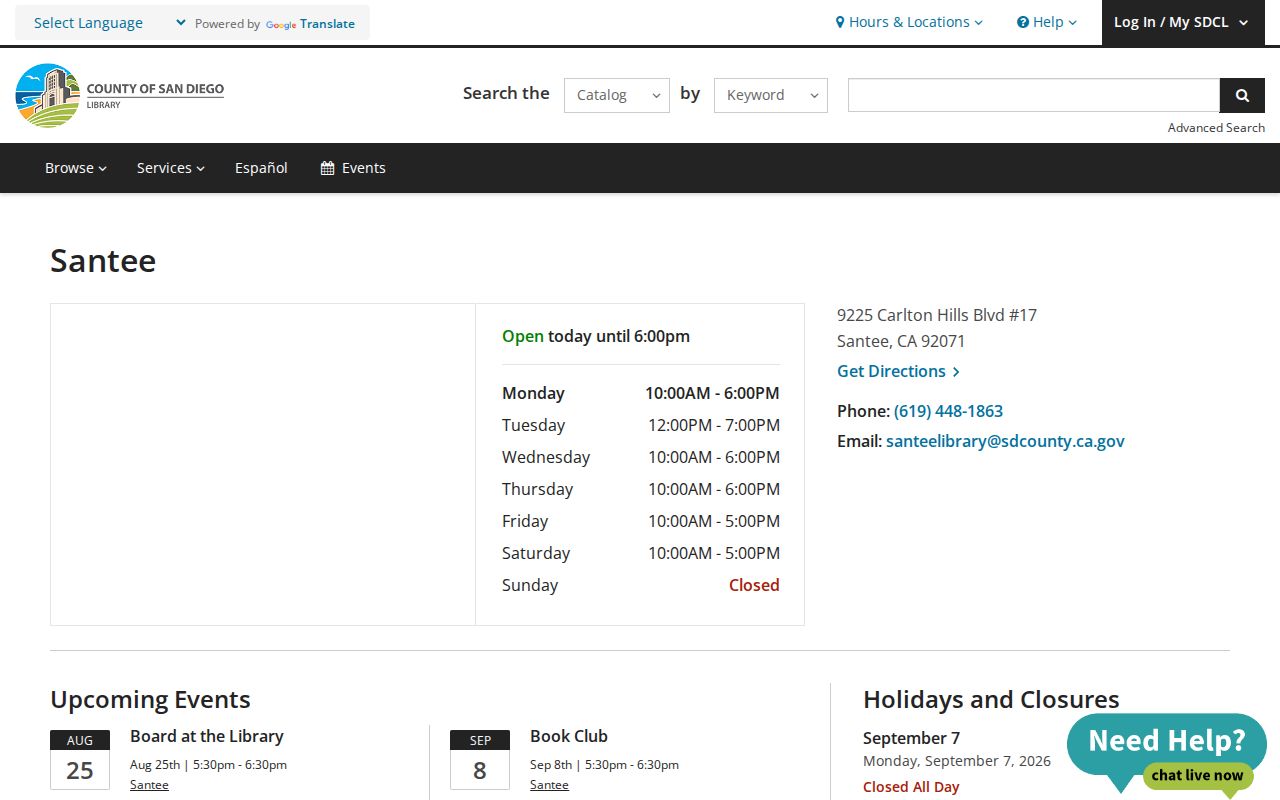
Library staff can also point to branch-to-branch borrowing and the county's licensed electronic resources.
Search Santee Directories in Digital Collections
Digitized San Diego directories are a lead, not a guaranteed Santee shelf. The Internet Archive search for the San Diego Directory Company can return several items with different years and geographic scope. Open the item, inspect its title page and contents, and confirm that Santee or the relevant East County place appears in that volume. OCR can miss broken type, initials, and street names, so inspect the page image when a family clue matters.
San Diego County Library's digital history collections add photographs, maps, and documents that may place a person or street in context. These visual records can support a directory clue, but a caption or contributor label is not the same as a contemporaneous resident roll.
The digitized directory search is the correct starting collection link.
Save the item's URL, title, year, page, and coverage statement because search-result displays can change.
Trace One Santee Household Across Years
A useful city directory trail is a sequence, not a single hit. Start with a full name, a likely address, and a time window. Log every appearance, move, spouse notation, and gap. Then compare the sequence with the public census years and with the deed or parcel record. Census schedules describe a household on an enumeration date; deeds describe title; a directory records what its publisher captured.
- Find the earliest plausible alphabetical entry and write down the volume, page, address, and printed spelling.
- Check the next available years, including regional titles where Santee is a place section rather than the title.
- Flip to the reverse section for the street and number; compare nearby entries and alternate address forms.
- Pair the directory snapshot with the 1950 census or another public schedule, using historic enumeration geography.
- Close a gap with deeds, permits, newspapers, probate, or an obituary, and label each source by what it actually proves.
Disappearance can mean a move, death, unlisted number, publisher gap, address change, or a name variation. Do not choose among those explanations until another source supports it.
Research Santee Families at County Archives
San Diego County Archives is located at 10144 Mission Gorge Road in Santee. Established in 2020 within ARCC, it preserves permanent county records from 1850 forward, including maps, recorded instruments, administrative files, and historic birth, death, and marriage material. The archive's finding aids and reading room extend the historical trail beyond a digitized city directory.
This is especially useful when a pre-1980 directory uses a county or settlement name. A researcher can bring a title page, a page number, a parcel clue, or a family name and ask for the record series that can test it. Contact archives@sdcounty.ca.gov or 619-237-0502 before travel.
The SDCL digital history collections provide a separate online context layer.
County archive custody begins in 1850 even though the online Recorder index begins in 1970, so the web cutoff is not the beginning of the record series.
Santee Historical Society Local Clues
The Santee Historical Society preserves local history around the Edgemoor Barn area at 9200 North Magnolia Avenue. Its collection work has included newspaper articles, displays, acquisitions, photographs, and community material. Those items can supply a landmark, school, tract, or family clue that points back to a formal directory or county record.
Contact the Society at 619-449-2024 and ask what is publicly accessible before describing a collection as a name index. The society's material is a local-history lead. A present-day membership list or private roster should not be treated as a public directory.
The Santee Historical Society page is the collection-level entry point.
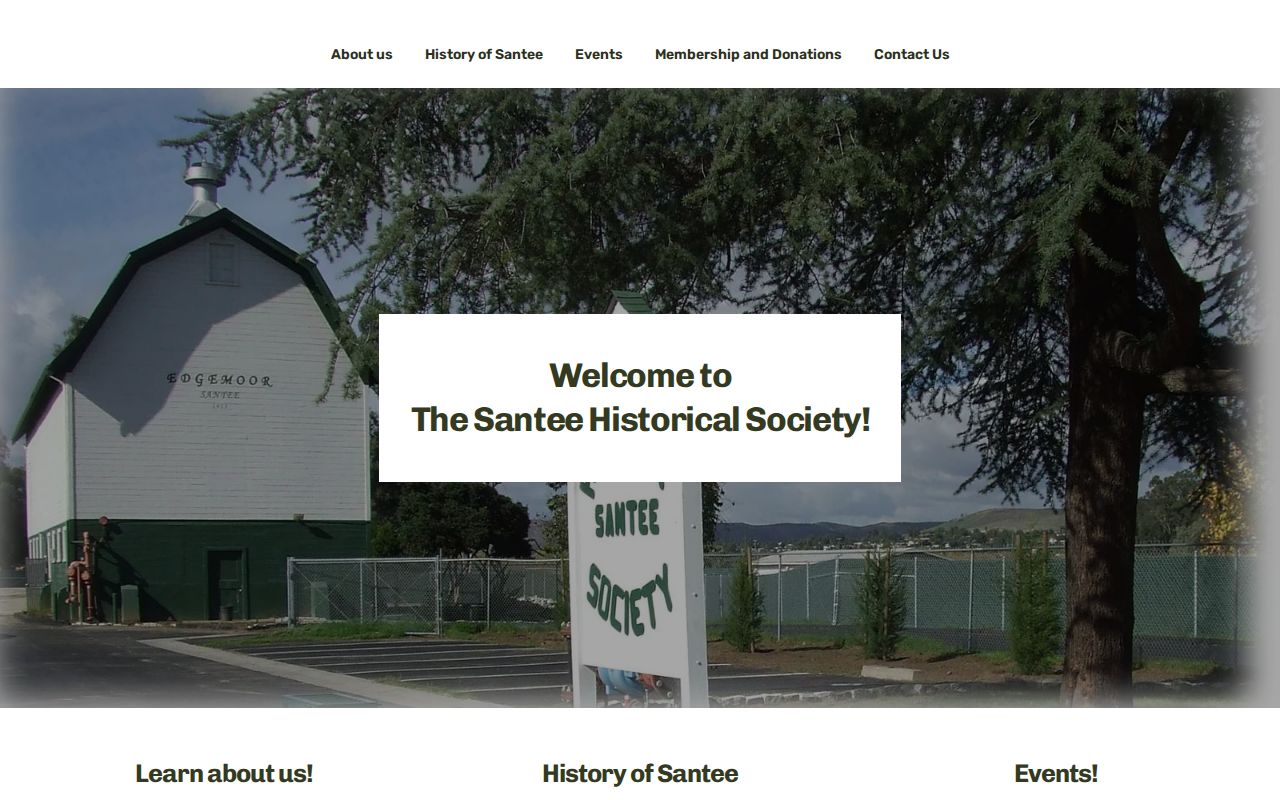
Use a clipping or photograph to locate a date and place, then verify the person in the relevant public source.
The 1958 to 1980 Santee Directory Shift
Postwar growth changes what a city directory search can find. The Carlton Company acquired about 4,300 acres in 1958. Santee's population grew from fewer than 2,000 in 1950 to 25,750 in 1970, then the city incorporated in 1980. Subdivision maps, school material, permits, assessment rolls, telephone books, and reverse directories become more useful during that development era.
The numbers do not create a resident list. They explain why a modern street may first appear in a tract map, why a directory may use a regional heading, and why an old household search benefits from both land records and community sources. The strongest family-history result is a directory snapshot paired with census relationships, deed ownership, and an obituary or probate record.