
What a Santee Resident Lookup Can Confirm
Different records answer different identity questions. A resident lookup should name the question before it names the person. A deed party is not automatically a resident. A court party is not automatically the same person as a licensee. A vital record may be obtainable only as an informational copy. The table is a map of useful starting points, with the access path that the Santee research supports.
| Record | What it confirms | Where | Access |
|---|---|---|---|
| Assessment and parcel | APN, property context, assessed owner through permitted channel | San Diego ARCC Assessor | Web parcel tools, phone, kiosk |
| Recorded documents | Grantor, grantee, lien or deed role and date | ARCC Official Records Index | Free index, kiosk image, copy order |
| Court case | Party name, case type, number, location, filing context | San Diego Superior Court | Free index; files by court rules |
| Vital record | Birth, death, marriage, or divorce metadata | ARCC, CDPH, or court | Authorized or informational route |
| Voter status | One voter's registration or ballot status | California and San Diego voter tools | Self-authentication or approved file use |
| Business or license | Entity, agent, credential, status, or public business address | SOS, DCA, FBN, ABC | Free public search, role-limited |
Begin with the source closest to the known fact. An address points toward parcel and permit systems. A probate question points toward the Superior Court. A family-history question may start with a directory or obituary and then move to a certificate request.
Search Santee Court Parties With Context
San Diego Superior Court's Court Index covers Civil, Criminal, Family, Mental Health, and Probate search modes. Santee has no independent municipal court. The East County Division in El Cajon is nearby, but the returned case location controls where a file is held. The public index generally reaches back to 1974, while juvenile, traffic and minor-offense matters are excluded. Civil and probate registers of action cover cases initiated on or after January 1, 2008.
| Field | Type | Use | Limit |
|---|---|---|---|
| Party last name | Text | Primary party search | Exact and variant spellings can differ |
| Party first and middle name | Text | Reduce same-name results | Not every case has a middle name |
| Date of birth | Date or text | Criminal search discriminator where available | Never infer it from a different record |
| Case type and location | Dropdowns | Narrow the court path | Case assignment determines the facility |
| Case number | Text | Direct case route | Modern format preserves leading zeros |
| DA case number | Text | Criminal route when known | Only useful if the number is available |
The Superior Court party search returns case title, case number, location, type, filing date, and involved parties. A case detail can expose a register of action link, entry dates, filing or scheduling descriptions, hearing information, and filters. It is an index, not the official case file.
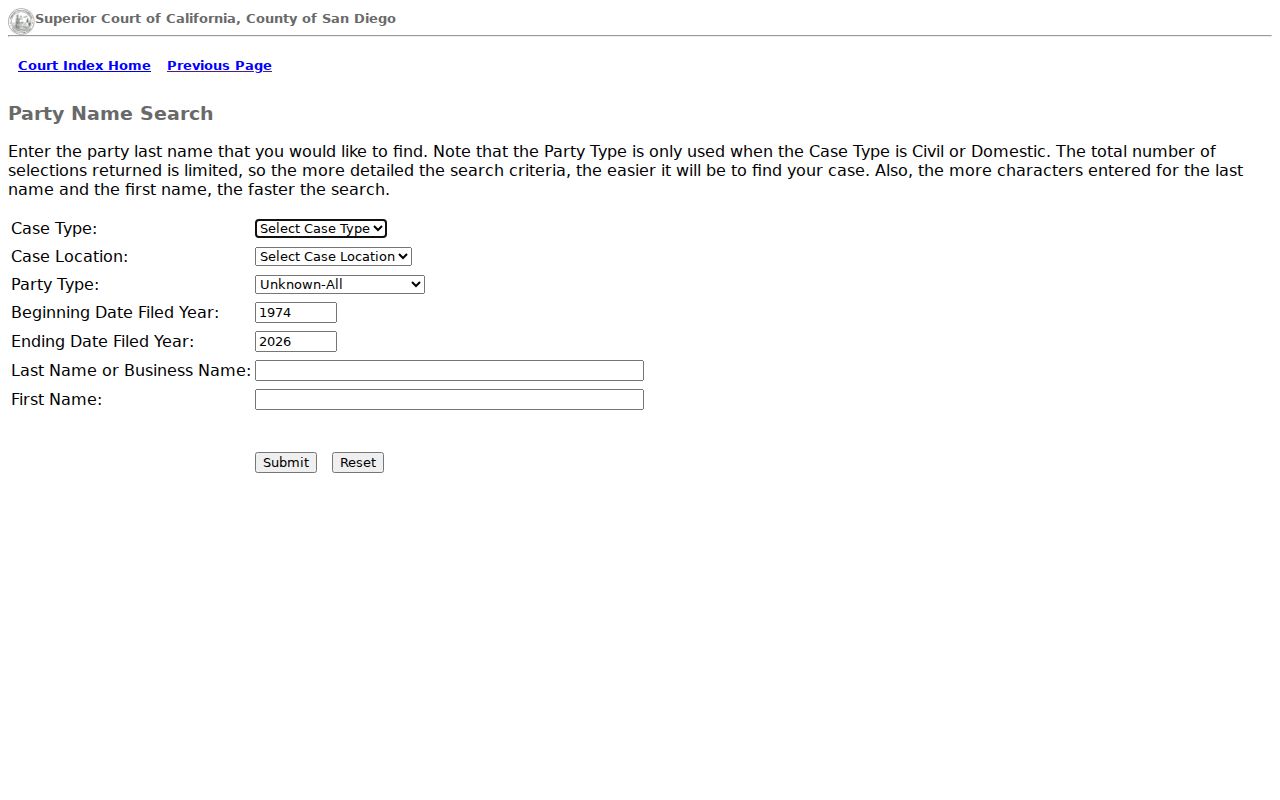
When more than 100 register entries exist, the printable all-entries option is the court's documented workaround. Sealed, confidential, juvenile, and protected material remains outside the public result.
For a public file, use the assigned courthouse, an eligible online purchase, or a mail route stated by the court. Older retained material may sit on courthouse microfilm for self-service research, and court staff do not perform that microfilm search for a requester. Criminal documents have different access and delivery rules from civil, probate, and selected family records.
Sample result fields: case title, case number, facility, category, filed date, party role, register entry date, description, hearing date and department, plus available filters. A name hit alone does not prove identity, residence, outcome, or guilt.
Santee Vital Records Follow Copy Rules
For Santee events, San Diego County ARCC is the local route for birth, death, and marriage copies. California Department of Public Health supplies a statewide route. Divorce files and decrees belong to San Diego Superior Court; CDPH may issue a Certificate of Record for qualifying years, but that certificate is not the decree.
California separates authorized certified copies from informational certified copies. An authorized copy is limited to the registrant, close family, an entitled representative, a court-authorized person, specified government personnel, and other statutory categories. An informational copy may be available to a wider requester but is marked not valid to establish identity. Confidential marriage certificates are limited by Family Code section 511. Adoption records are sealed under Health and Safety Code section 10570 and Family Code section 9200 and related rules.
| Record | Local custodian | Access path | Published ARCC fee |
|---|---|---|---|
| Birth | ARCC or CDPH | Authorized or informational application | $32 on June 30, 2025 schedule |
| Death | ARCC or CDPH | Authorized or informational application | $24 on June 30, 2025 schedule |
| Marriage | ARCC | Public or confidential route as applicable | $17 on June 30, 2025 schedule |
| Divorce | Superior Court | Court file or CDPH certificate route | Current court or state schedule |
A mailed authorized-copy request needs a sworn statement acknowledged before a notary. County in-person service can handle the identity process at the counter. Use the current application because fees, accepted ID, and payment instructions can change.
Verify a Santee Name Across Records
A reliable resident lookup uses two independent anchors. Start with the known fact, not a favorite portal. If the known fact is an address, resolve the APN and keep the situs address separate from the owner's mailing address. If the known fact is a family event, use the certificate or probate route. If the known fact is a public case, capture the case number and role before comparing names.
- Normalize the name, including middle initials, suffixes, former surnames, trust or entity forms, and older Recorder abbreviations.
- Anchor the name to a parcel, court number, license number, business filing, date, or documented family connection.
- Search the matching official index and save the exact result fields, date, and custodian.
- Compare a second source, such as a deed image, probate file, obituary, directory page, or license status.
- Order a certified or informational copy only when the record type and eligibility fit the purpose.
- Docket or register of action
- A court chronology of filings, settings, and other recorded events; it is not the full file.
- Index versus image
- An index locates a record through metadata. An image or file contains the underlying document when public and available.
- Certified copy
- A copy issued by the custodian with a certification that carries the legal status stated for that record.
- Informational copy
- A certified record copy marked so it cannot be used to establish identity in the way an authorized copy can.
If the goal changes from one person to everyone along a street, use the Santee street directory workflow instead. Historical household evidence belongs in the Santee city directory collections.
Santee Voter Status Is Self-Only
California My Voter Status requires the voter's first and last name, birth date, and identity route. San Diego County's voter lookup similarly checks residence address, birth date, and ZIP against the county file. A mismatch can mean an address, birth date, or ZIP differs, the person lives outside the county, or a new registration is still being processed.
Broader file access is limited by Elections Code section 2194, Government Code section 7924.000, and the county application rules. An approved request can require an original wet signature, photo ID, purpose documentation, security details, and fees. It is not a personal shortcut for listing Santee residents on a block.
The California My Voter Status form shows the self-lookup path.
Use a voter result only for the voter who authenticated or for an approved purpose described by the election office.
Use Santee Business and License Roles
California bizfile Online can distinguish a business entity by name or file number. DCA's multi-board search can use board, license type, number, person name, business name, city, or county. Fictitious-business-name filings add a county business and registrant layer. ABC's lookup can search by Santee city, ZIP, address, licensee, or DBA. These results are useful when a name needs a role or date anchor.
A licensee, agent for service, officer, manager, permit applicant, and business registrant each have a different relationship to an address. Keep that label in the notes. A public business address can corroborate a Santee connection, but it does not establish a home or identify every person at the location.
The California Department of Consumer Affairs search is the source for the credential layer.
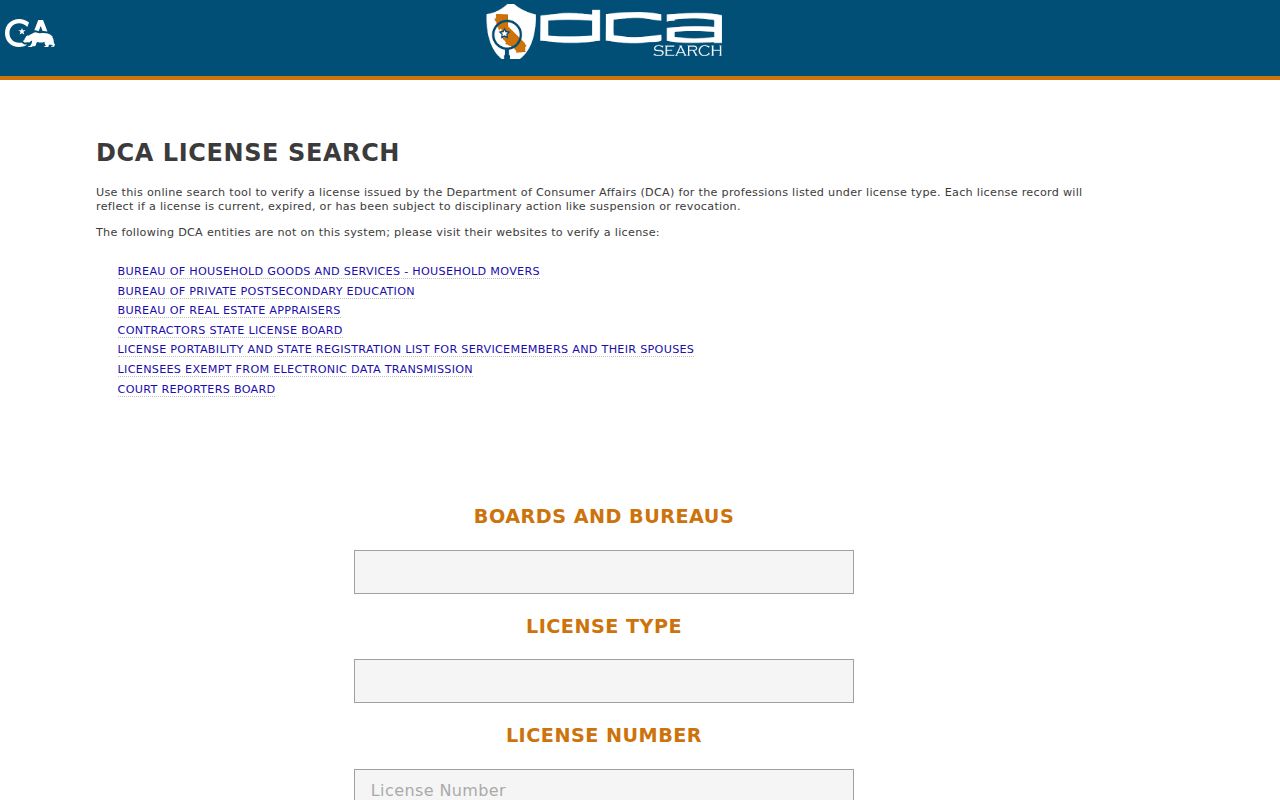
Save license number, status, board, and public address when they are displayed, then confirm disputed details with the board.
Separate Santee Custody From a Resident Record
The San Diego County Sheriff's Who's in Jail tool is a current-custody lookup. The California Department of Corrections and Rehabilitation locator covers state-prison custody. Federal matters use the Bureau of Prisons locator. California's Megan's Law site is a statutory registry with its own exclusions and use warnings. None is a complete resident directory or a lifetime case history.
Same-name risk is high. Use a booking, CDCR, case, agency, or institution identifier when one is available. A custody result describes the scope and timing of custody. It does not prove current residence in Santee, an offense outcome, or identity without corroboration.
The Sheriff's current custody lookup is the official county route.
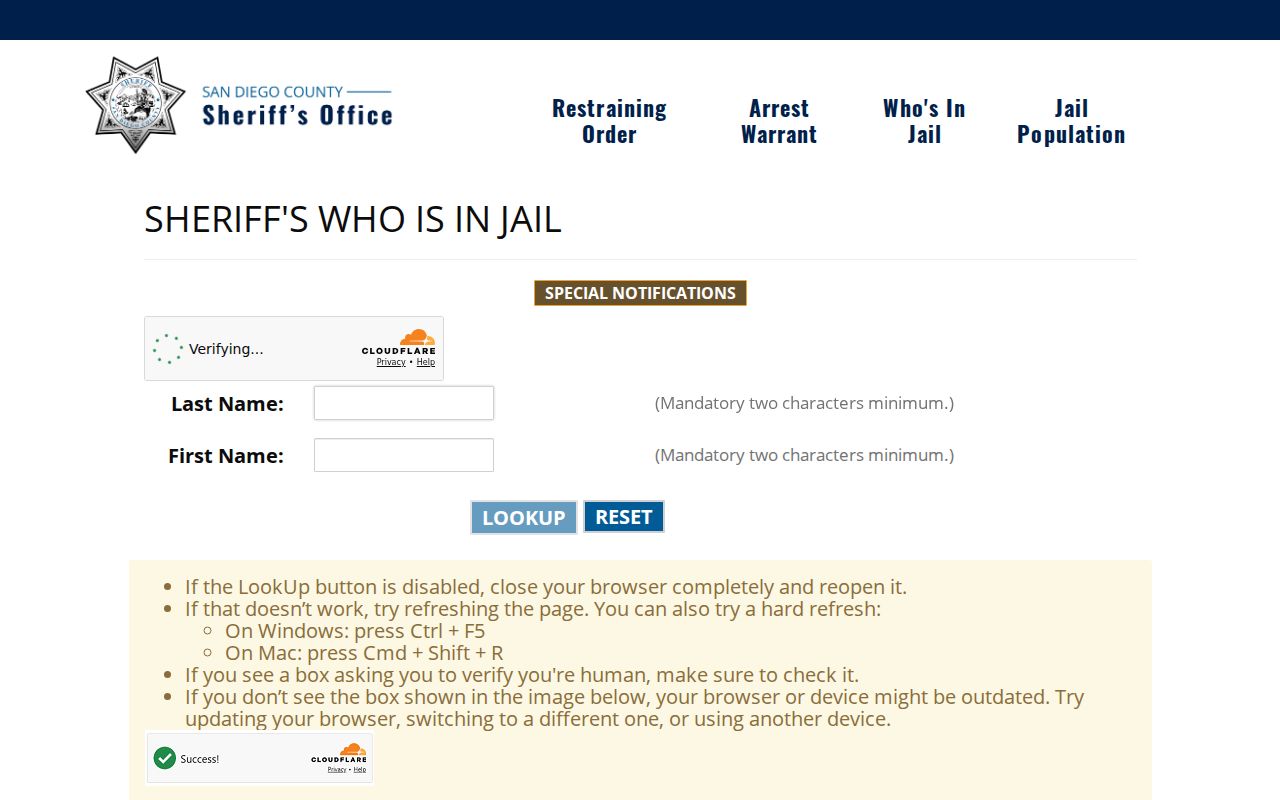
For one's own local criminal-history request, the Sheriff requires its form and identification; a public name search is not a substitute.
Resolve Same-Name Santee Results
When two Santee results share a name, compare dates, middle names, suffixes, parcel or mailing context, case role, license number, relatives, and document chronology. A recorder party plus matching legal description is stronger than a recorder party alone. A court party plus a case number and location is stronger than an indexed name. An obituary plus relatives and a date can distinguish a past resident from a living person with the same name.
For an heir, begin with Superior Court probate and connect the decedent to deeds or death evidence. For a former classmate, use school yearbooks and library sources. For a birth-parent question, use California's official confidential adoption-information channels. Protected voter, Safe at Home, sealed court, juvenile, DMV, and utility data are boundaries, not puzzles to defeat.
Legal Limits on a Santee Resident Lookup
California's privacy rules affect both the source record and copies made by commercial compilers. Safe at Home can substitute a mailing address for qualifying participants. CCPA and California Privacy Rights Act rights can reach covered commercial data, and the 2026 DROP tool can send one request to more than 500 registered brokers. Those rights do not rewrite a lawful deed, court index, or assessor record. Corrections belong with the custodian that created the record.
Lawful use. A Santee resident lookup is for personal, lawful research such as family history, estate work, civic review, or checking a possible scam. Do not use a name, address, court, or custody result to stalk, harass, threaten, or harm anyone.
Verify important facts with the office that holds them. A responsible result may be narrower than the original question, especially when a person is protected or a source does not lawfully disclose the requested detail.